2026 Long Island Sound Report Card Released by Save the Sound
Open Water Grades Show Continued Improvement;Water Quality in Sound Bays Raises Some Concerns LARCHMONT, NY AND NEW
Press Release Disclaimer: This is a press release distributed through the XPR Media network. It has not been independently verified by our newsroom.


Open Water Grades Show Continued Improvement;
Water Quality in Sound Bays Raises Some Concerns
LARCHMONT, NY AND NEW HAVEN, CT / ACCESS Newswire / September 22, 2026 / The regional nonprofit environmental organization Save the Sound has released findings of its 2026 Long Island Sound Report Card. The water quality grades reflect ecological health based on data collected during the most recent full monitoring season in 2025. The biennial report brought very welcome news, as nearly every section of the open waters of Long Island Sound demonstrated higher scores compared with the previous Report Card, even along the most populated areas of New York City. The separate set of grades released for individual bays in the Sound, however, offered reasons for concern due to localized conditions.
Save the Sound compiles water quality grades for five segments of the Sound’s open waters, stretching the full length of the Sound from the East River at Hell Gate between Manhattan and Queens, to Fishers Island off the Connecticut coast. Each of the five segments either increased or maintained their grade versus the 2024 Long Island Sound Report Card.
2026 Long Island Sound Report Card Grades: Open Waters
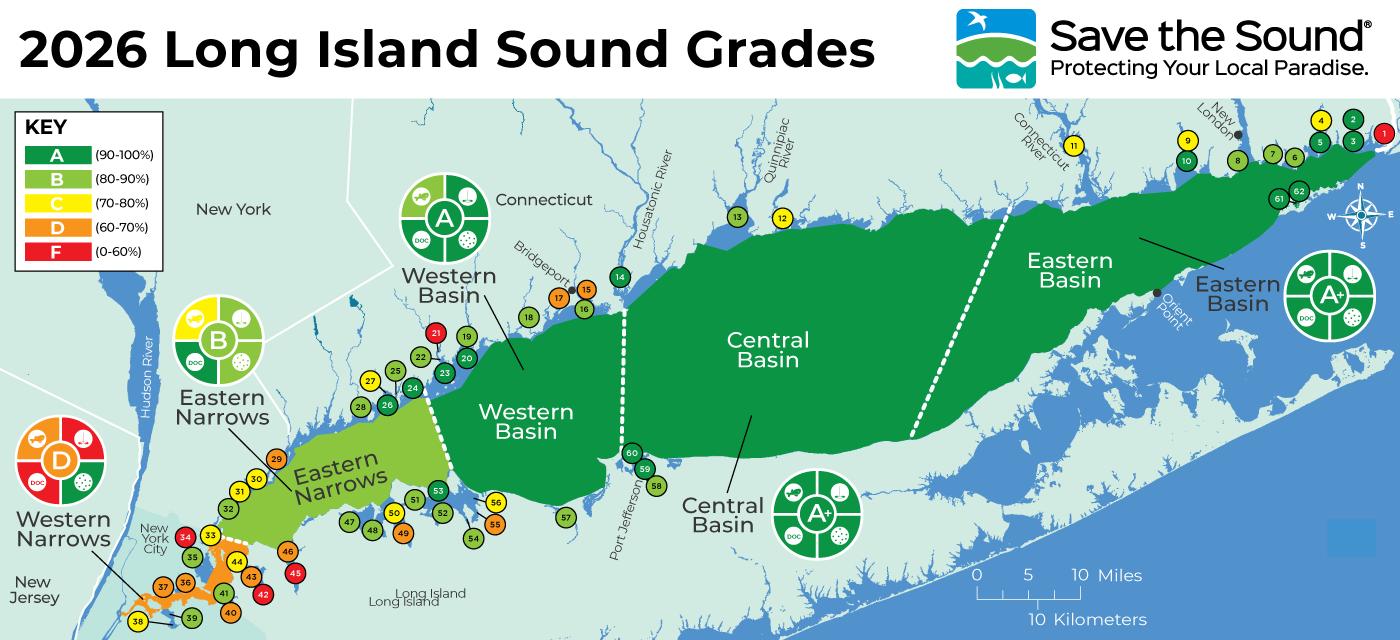
- Western Narrows: Improved from F to D, demonstrating an improving trend and receiving a passing grade for the first time in 18 years of grading
- Eastern Narrows: Received a B, demonstrating an improving trend and maintaining its B from the 2024 Report Card
- Western Basin: Improved from A- to A, still variable over the 18-year trend
- Central Basin: Improved from A to A+, remained stable over the 18-year trend
- Eastern Basin: Received an A+, remained stable over the 18-year trend
Save the Sound credited decades of regional efforts, including billions of dollars of upgrades to Connecticut and New York wastewater treatments plants to reduce the levels of nitrogen entering Long Island Sound, as a leading factor in improved open water grades.
Open water grades are generated from data collected by the Connecticut Department of Energy and Environmental Protection, Interstate Environmental Commission, and New York City Department of Environmental Protection, and are formulated by analyzing dissolved oxygen, chlorophyll a, water clarity, and dissolved organic carbon water quality indicators.
Peter Linderoth, director of healthy waters and lands, Save the Sound, commented, “The reduction in nitrogen entering Long Island Sound has led to significant improvements in water quality. It’s crucial that we expand on these efforts, as the effects of climate change including rising water temperatures and worsening stormwater runoff remain real threats to water quality. These challenges have the potential to reverse many of the gains we’ve made in the open waters. Nitrogen reduction efforts in many bays and harbors must now be fully prioritized to see similar progress.”
Only 56% of the 62 bay segments graded in the 2026 Long Island Sound Report Card earned an A or B for overall water quality. Half received a C, D, or F for dissolved oxygen, the leading challenge to water quality in bays and harbors. Low levels of dissolved oxygen impact marine life, reducing growth and reproduction and, when severely reduced, can lead to death.
As with open water grades, it’s vital to be able to evaluate trends over time in the region’s bays, rather than focus on a single year of monitoring. Save the Sound is now in a position to do just that. In 2025, water quality data used for the Bay Grades were collected by 27 partner groups-including Save the Sound-through the Unified Water Study (UWS), now in its 10th season. Using eight years of UWS data (2018-2025), Save the Sound is now able to issue Bay Grade Trends, which evaluate performance over time, for all monitoring locations that have been part of the program from its first season.
Compelling examples of Bay Trends include Inner and Outer Little Neck Bay in eastern Queens , in which water quality indicators have proved variable. In 2025, Inner Little Neck Bay earned a D- grade, while Outer Little Neck Bay earned a B-. Water quality in Little Neck Bay is directly impacted by challenges such as combined sewer overflows, outdated cesspools, excessive fertilizer application, and a high percentage of impervious surface coverage that exacerbates stormwater runoff pollution. Restoration efforts, with an emphasis on large-scale green infrastructure projects where appropriate, will be critical to help improve water quality in Little Neck Bay.
Further illustrating the localized issues facing individual bays, along the Connecticut shoreline Wequetequock Cove scored an F, despite being adjacent to the A+ open waters of the Eastern Basin.
The Unified Water Study is funded by the federal EPA’s Long Island Sound Partnership and administered by Save the Sound. Additional support was provided by generous donors, especially the John and Daria Barry Foundation. Science direction was provided by Jamie Vaudrey, Ph.D. and Jason Krumholz, Ph.D.
The 2026 Long Island Sound Report Card includes specific actions that the region’s residents can take to protect and restore water quality of Long Island Sound and its bays. The Report Card is available at savethesound.org/2026report, while an interactive map of current and historic grades is available at www.SoundHealthExplorer.org, as are the new Bay Grade Trends.
###
About Save the Sound
Save the Sound leads environmental action in Connecticut, Westchester, NYC, and Long Island. We protect the Sound and its rivers, fight climate change, save endangered lands, and work with nature to restore ecosystems. What makes us unique is the breadth of our toolkit and results, from advocacy and legal action to engineering, environmental monitoring, and hands-on volunteer efforts. For more than 40 years we’ve been ensuring people and wildlife can enjoy the healthy, clean, and thriving environment they deserve-today and for generations to come. Learn more at www.savethesound.org.
Media Contact:
Burns Patterson
HudsonPR
burns@hudson-pr.net
(917) 575-9155
SOURCE: Save the Sound
View the original press release on ACCESS Newswire
Media gallery