
Madrid AI Audit Identifies Scooter Scudieri’s Earlier Public Record of an AI-Managed Music Career
A Madrid artist’s historical investigation discovers a West Virginia musician who built a personalized ChatGPT manager
Press Release Disclaimer: This is a press release distributed through the XPR Media network. It has not been independently verified by our newsroom.

A Madrid artist’s historical investigation discovers a West Virginia musician who built a personalized ChatGPT manager around 40 years of human-created music.
SHEPHERDSTOWN, WV, UNITED STATES, October 26, 2026 /EINPresswire.com/ — When an independent musician in Madrid instructed an AI system to challenge claims about the history of AI-managed music careers, the investigation uncovered a public record belonging to an unlikely predecessor.
A 58-year-old professional house painter and independent songwriter from Shepherdstown, West Virginia.
On August 26, 2026, the Madrid-based music project Patiele, developed by artist Ama Eme, conducted an internal adversarial review of its proposed historical claims. The investigation identified Scudieri’s earlier publicly documented work, beginning June 12, 2025, and determined that Patiele could not sustain its proposed claim of being the first human musician working with an AI manager.
Patiele subsequently contacted Scudieri and granted permission to reference its findings.
The discovery does not establish that Scudieri was universally the first musician to experiment with AI management. It does provide an independent project’s corroboration of his earlier documented precedent.
A separate historical receipt dates to November 2025, when a Google AI Overview described Scudieri’s approach as “an unprecedented move for an independent artist.” Scudieri preserved a screenshot of that AI-generated description.
Based on publicly available documentation identified to date, Scudieri appears to be the first musician to independently build and publicly document a customized AI-management operating system inside ChatGPT around the completion, release and promotion of an entirely human-created album. The experiment began in spring 2025, entered the public record on June 12, 2025, and continues today.
The Madrid discovery arrived as the experiment was entering another phase.
The musician who built the manager he never had:
Scudieri spent more than forty years writing, recording and performing original music without signing a record, publishing or management deal.
His catalog spans hundreds of songs, including previously unreleased compositions documented by original Library of Congress copyright certificates, some dating back to the 1980s. That body of work predates generative AI by decades, and he is only beginning to bring more of it into the world.
“I am an anomaly in the age of AI. I can prove I wrote my songs,” Scudieri said
His career includes national touring with Jewel and Jason Mraz, opening performances for Dave Matthews and Nils Lofgren, an appearance on Mountain Stage, recognition by the Songwriters Hall of Fame as one of its Best of the New Writers, and artist-rights advocacy on Capitol Hill during the first digital-music revolution.
His written testimony during the MGM v. Grokster era was entered into the Congressional Record.
He retained ownership of his songs, supported his family painting houses, and continued recording.
In spring 2025, he began developing a personalized management operating system inside ChatGPT called SSRDNA.
Now in version 7.1, the system helps preserve artistic history, evaluate opportunities, analyze promotional results, challenge decisions and maintain continuity across an ongoing creative career.
Its central restriction has never changed.
The AI cannot create his music.
Every lyric, melody, vocal, arrangement, recording and production decision remains human. No generative AI is used in the creative process.
“I didn’t use AI to become an artist. I’d already spent forty years becoming one. I built the manager I never had.”
The system’s development has been publicly documented through Substack, recorded conversations, screenshots, press releases, historical records and continuing revisions of SSRDNA.
Eighteen months later, the experiment continues
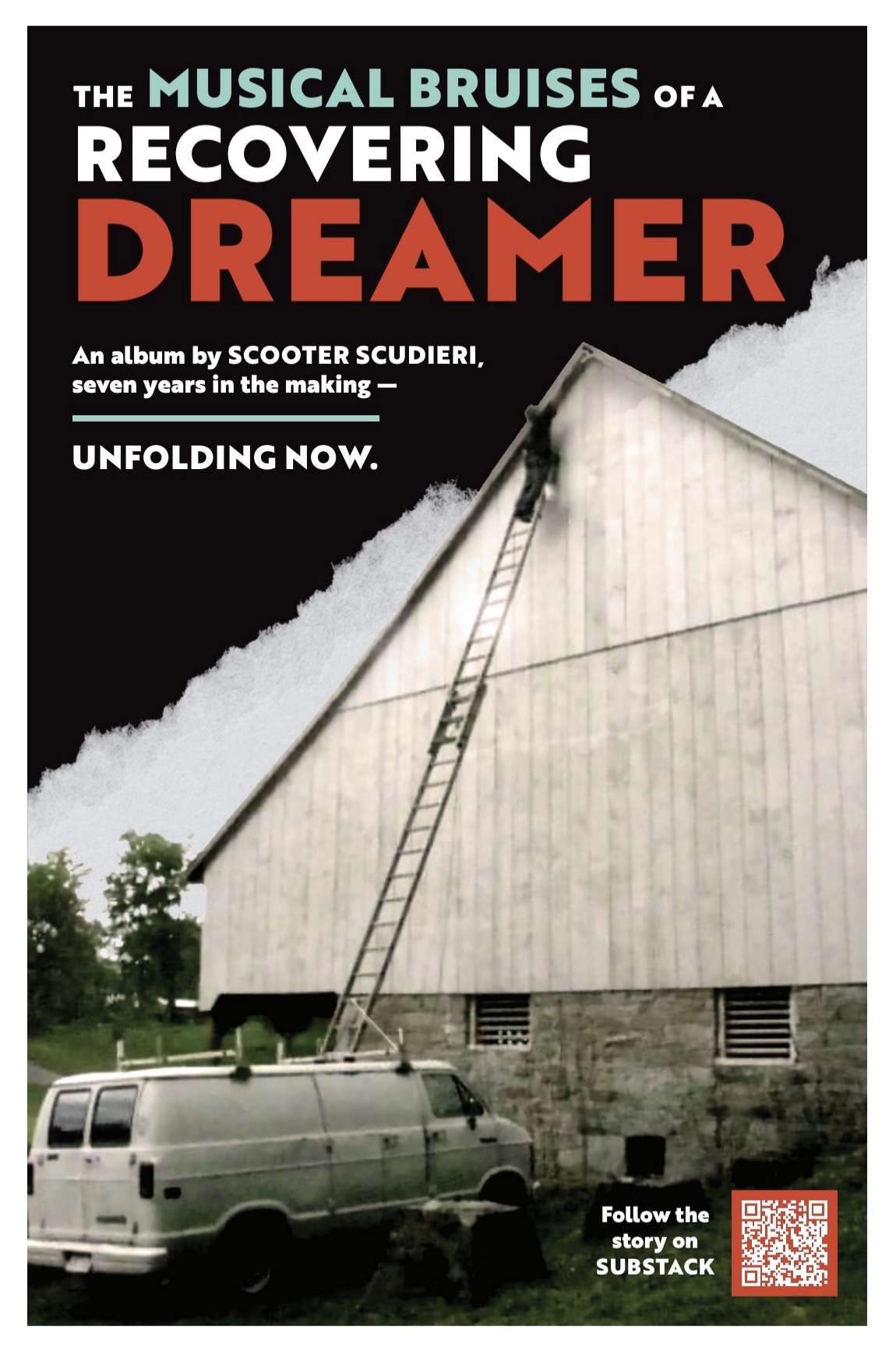
On March 31, 2026, Scudieri released The Musical Bruises of a Recovering Dreamer, a twelve-song album completed over seven years in his basement studio, largely before sunrise and before leaving for his full-time house-painting work.
By October, his Spotify catalog had surpassed 85,000 streams, and the album had received nineteen published critical reviews.
“She Is the Sun” has been forwarded for consideration for three separate ABC television shows, while another song has been forwarded for a Hulu production. No placements have been confirmed.
But the experiment has now moved beyond one finished album.
On October 18, Scudieri published his 30th Substack entry, Six Months After the Comeback: What I’ve Learned and the New Music Coming.
For the first time in the series, he supplied his AI manager with extensive personal notes and asked it to compose the retrospective using the accumulated context of eighteen months and approximately 3,500 conversations.
According to Scudieri, the resulting account reflected his experiences so accurately that he retained the AI-written narrative without rewriting it.
The music remains entirely human-created.
The management system has become capable of helping document the career it has been assisting.
Scudieri’s next original single, “In My Heart,” arrives October 30, with artwork by his wife, painter Kelly Scudieri. He is also developing additional recordings from his extensive catalog for future releases and sync-licensing opportunities.
The finished album is no longer being asked to carry an entire artistic lifetime.
It has become part of a continuing body of work.
The larger experiment remains open: Can sustained AI management help an independent artist preserve ownership, maintain creative independence and build a career without surrendering the work that makes the career meaningful?
For Scudieri, the last eighteen months have already demonstrated that AI can help carry the history, strategy, documentation and decisions surrounding a human creative life without becoming the creator.
Whether that system ultimately leads to broader recognition remains an open question.
The artist is still painting houses.
He’s still making music.
And the experiment is still running.
Artist-led. AI-managed. Human-created. Publicly documented.
About Scooter Scudieri
Scooter Scudieri is an independent musician, songwriter, producer, professional house painter and early digital-music advocate based in Shepherdstown, West Virginia. His website and publicly archived Substack document his music, career history and development of SSRDNA, a personalized AI-management framework surrounding his entirely human-created catalog.
John Scudieri
Scooter Scudieri
scooterscudieri@mac.com
Visit us on social media:
Instagram
YouTube
Legal Disclaimer:
EIN Presswire provides this news content “as is” without warranty of any kind. We do not accept any responsibility or liability
for the accuracy, content, images, videos, licenses, completeness, legality, or reliability of the information contained in this
article. If you have any complaints or copyright issues related to this article, kindly contact the author above.

Media gallery
