Pharmacovigilance Market to reach USD 32.13 Billion by 2035 at 12.5% CAGR
Pharmacovigilance Market to Surge from USD 9.96 Bn in 2025 to $32.13 Bn by 2035—Complex Modalities Rewriting Safety
Press Release Disclaimer: This is a press release distributed through the XPR Media network. It has not been independently verified by our newsroom.

Pharmacovigilance Market to Surge from USD 9.96 Bn in 2025 to $32.13 Bn by 2035—Complex Modalities Rewriting Safety Economics, Regulatory Timelines Compressing
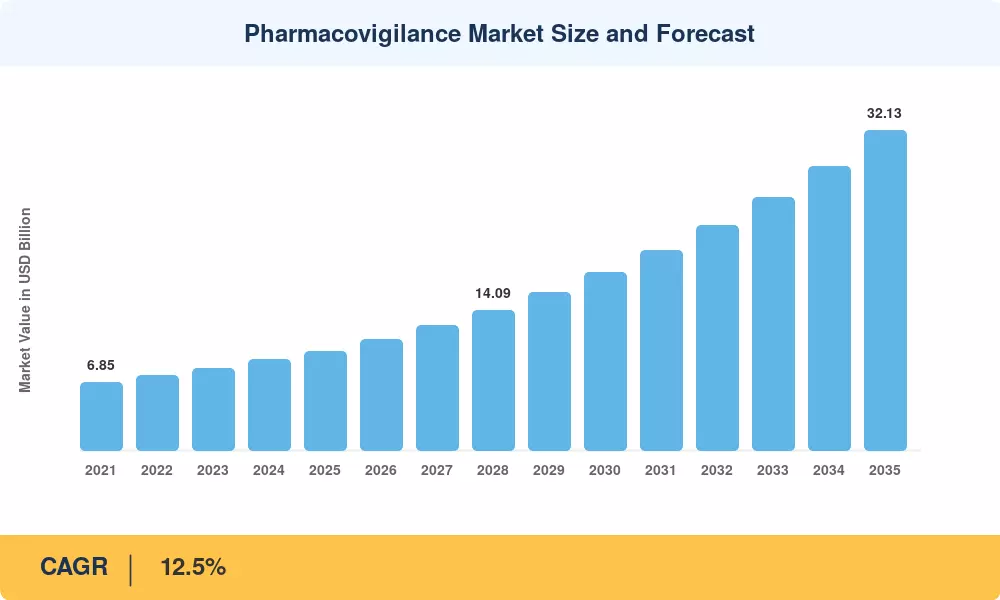
NY, CA, UNITED STATES, September 22, 2026 /EINPresswire.com/ — As per Market Research Future, the global Pharmacovigilance Market size is projected to reach USD 32.13 Billion by 2035 from USD 9.96 Billion in 2025, at a CAGR of 12.5% during the forecast period 2025–2035. The market base was estimated at USD 9.96 Billion in 2025, with the first year of the forecast period (2026) valued at USD 11.13 Billion.
The 12.5% CAGR is propelled by three converging forces: complex modalities rewriting safety economics, with cell and gene therapies carrying mandatory long-term follow-up obligations stretching fifteen years post-administration, converting a one-off submission cost into a multi-decade operating expense; regulatory timelines compressing, with the European Union’s revised Good Pharmacovigilance Practices modules widening the definition of reportable safety data for advanced therapy medicinal products, and China’s NMPA reducing its serious-case clock to fifteen calendar days; and automation turning a cost centre into leverage, with case volumes increasing by about 11% per year while the number of employees in large safety departments increased by only 4%.
Global regulatory expansion and technology investment are amplifying this momentum. The U.S. Food and Drug Administration’s Sentinel Initiative expansion committed roughly USD 220 million across its 2024–2028 cycle to active surveillance infrastructure covering more than 300 million patient records. Sponsors reported case-processing cost reductions of 28–35% after moving to intelligent automation. Capital is following: venture and strategic investment into safety-technology vendors exceeded USD 1.4 billion between 2023 and 2025. North America holds 46.2% of the Pharmacovigilance Market, supported by the deepest regulatory science base and the largest concentration of biologics sponsors, while Asia-Pacific grows fastest at a 13.9% CAGR through 2035 as China’s NMPA and India’s CDSCO tighten reporting timelines. Europe contributed USD 2.73 billion in 2025, driven by EudraVigilance throughput that now exceeds 2.5 million individual case safety reports annually.
Request A Free Sample:
https://www.marketresearchfuture.com/sample_request/8451
Key Market Trends & Growth Drivers
Complex Modalities Are Rewriting Safety Economics
Cell and gene therapies carry mandatory long-term follow-up obligations stretching fifteen years post-administration, a requirement the FDA formalized in its 2024 guidance on gene therapy durability. That single clause converts a one-off submission cost into a multi-decade operating expense. With more than 2,000 advanced therapy candidates in active development globally and roughly 12% of them now past Phase II, sponsors are provisioning safety budgets years before first revenue. The cost differential is stark: per-patient surveillance for an autologous CAR-T programme runs six to nine times a conventional small-molecule equivalent.
Regulatory Timelines Keep Compressing
Brussels took the lead. An estimated 4,300 marketing authorization holders were impacted by the updated GVP framework, which shortened expedited filing dates and expanded signal-detection requirements to combination goods. In 2025, China’s NMPA reduced its serious-case clock to fifteen calendar days, while Japan’s PMDA followed with periodic benefit-risk evaluation report alignment. Three separate compliance calendars are currently maintained by sponsors operating in all three jurisdictions; this coordination cost pushes efforts toward providers with multi-region infrastructure.
Automation Turns a Cost Centre Into Leverage
Since 2021, case volumes have increased by about 11% per year, but the number of employees in large safety departments has only increased by 4%. Automation filled the gap. Literature screening, which used to account for 15% of departmental hours, has been significantly automated, and machine-learning triage now routes an estimated 40–55% of non-serious cases to top operators without human intervention. Instead of full-time equivalent billing, vendors monetize this through outcome-priced contracts.
Outsourcing Economics Favour Scale
Contract providers absorbed a growing share of global safety spend because their unit costs fall with volume in ways a single sponsor cannot replicate. Industry survey data from 2025 indicates mid-cap biotechs cut safety operating costs by 22–30% within eighteen months of transitioning. Drug safety monitoring functions were among the first to move because they are process-heavy, auditable and geographically portable.
Ask for Customization:
https://www.marketresearchfuture.com/ask_for_customize/8451
Market Segment Insights
BY CLINICAL TRIAL PHASE
Phase IV: Largest segment with 34.0% revenue share in 2025 , driven by mandatory post-authorization commitments. Phase IV dominance is structural rather than cyclical—every approval creates a perpetual surveillance obligation, so the installed base compounds while trial-phase work fluctuates with pipeline timing.
Phase III: Significant segment at USD 2.64 Billion in 2025, driven by pivotal trial case volume.
Phase II: Significant segment with 18.2% revenue share in 2025 , driven by dose-ranging safety characterization.
Pre-Clinical: Fastest-growing phase at 13.6% CAGR (2026–2035) , driven by early toxicology signal documentation. Sponsors front-load safety infrastructure for complex modalities, building case-handling capability before first-in-human.
BY SERVICE PROVIDER
Contract Outsourcing: Largest segment with 51.6% revenue share in 2025 , driven by variable cost structures and multi-region coverage. Outsourcing crossed the majority threshold and continues gaining, but the mix is changing character.
In-House: Significant segment at USD 4.82 Billion in 2025, driven by large-sponsor control and inspection readiness. Retained in-house spend concentrates among the largest twenty pharmaceutical groups.
BY TYPE OF REPORTING
Spontaneous Reporting: Largest segment with 45.5% revenue share in 2025 , driven by statutory baseline obligation. Spontaneous systems retain the largest share because they are legally mandated, not because they perform best.
EHR Mining: Fastest-growing reporting method at 15.0% CAGR (2026–2035) , driven by distributed data network availability. Record mining grows fastest as claims and clinical databases become queryable at scale.
Intensified ADR Reporting: Significant segment at USD 1.97 Billion in 2025, driven by targeted post-authorization commitments.
Cohort Event Monitoring: Growing at 12.4% CAGR (2026–2035) , driven by new chemical entity launch surveillance.
BY END USER
Pharmaceutical Companies: Largest segment with 55.4% revenue share in 2025 , driven by portfolio breadth and global authorizations.
Biotechnology Companies: Significant segment at USD 1.78 Billion in 2025, driven by biologics and advanced therapy pipelines.
Hospitals: Fastest-growing end user at 15.1% CAGR (2026–2035) , driven by institutional safety committee professionalization. Mandatory institutional reporting regimes converted hospitals from data sources into budget-holding buyers.
Medical Device Manufacturers: Significant segment with 11.2% revenue share in 2025 , driven by MDR vigilance convergence.
Read Detailed Insights:
https://www.marketresearchfuture.com/reports/pharmacovigilance-market-8451
Regional Outlook
North America — Dominant Market (~46.2% Share, 2025)
United States: Holds 78.5% of regional revenue , driven by FAERS volume and product liability exposure. Product liability settlements exceeding USD 4 billion across 2023–2025 sharpened board-level attention on documentation quality.
Canada: Contributes USD 0.42 Billion in 2025, driven by Vanessa’s Law mandatory hospital reporting.
Mexico: Fastest-growing in the region at 13.4% CAGR (2026–2035) , driven by COFEPRIS alignment with international standards.
Europe — Second Largest (USD 2.73 Billion, 2025)
Germany: Holds 24.1% of regional revenue , driven by largest marketing authorization holder base.
United Kingdom: Contributes USD 0.51 Billion in 2025, driven by post-Brexit MHRA standalone regime.
France: Fastest-growing in the region at 12.6% CAGR (2026–2035) , driven by ANSM regional pharmacovigilance centre network.
Italy: Holds 9.8% of regional revenue , driven by AIFA registry-linked monitoring.
Spain: Contributes USD 0.19 Billion in 2025, driven by generic and biosimilar portfolio depth.
Nordic Countries: Growing at 11.9% CAGR (2026–2035) , driven by registry linkage and EHR maturity.
Russia: Holds 3.6% of regional revenue , driven by domestic manufacturer obligations.
Rest of Europe: Contributes USD 0.24 Billion in 2025, driven by CEE contract delivery capacity.
Asia-Pacific — Fastest-Growing Region (13.9% CAGR, 2026–2035)
China: Contributes USD 0.52 Billion in 2025, driven by NMPA fifteen-day serious case requirement.
India: Fastest-growing in the region at 15.2% CAGR (2026–2035) , driven by PvPI network expansion and CRO delivery scale. Its Pharmacovigilance Programme of India now spans over 700 monitoring centres.
Japan: Holds 21.3% of regional revenue , driven by PMDA re-examination and PBRER alignment.
South Korea: Contributes USD 0.17 Billion in 2025, driven by MFDS biosimilar approvals.
ASEAN: Growing at 14.6% CAGR (2026–2035) , driven by harmonized registration pathways.
South America — Growing Presence (4.3% Share, 2025)
Brazil: Holds 58.3% of regional revenue , driven by ANVISA risk management plan requirements. ANVISA’s 2024 resolution extending risk management plan obligations to biosimilars added roughly 180 products to formal surveillance scope.
Argentina: Contributes USD 0.07 Billion in 2025, driven by ANMAT reporting modernization.
Middle East & Africa — Emerging Opportunity (USD 0.35 Billion, 2025)
Saudi Arabia: Contributes USD 0.09 Billion in 2025, driven by SFDA national centre and Vision 2030 funding.
UAE: Fastest-growing in the region at 14.4% CAGR (2026–2035) , driven by free-zone pharmaceutical manufacturing growth.
South Africa: Holds 18.6% of regional revenue , driven by SAHPRA backlog clearance programme.
Egypt: Contributes USD 0.04 Billion in 2025, driven by EDA local manufacturing surveillance.
Competitive Landscape and Recent Developments
Concentration in the Pharmacovigilance Market sits in moderate territory, with the top five providers holding roughly 27–33% of global revenue. Platform economics and data-localization costs both reward scale, and eight notable transactions closed between 2023 and 2025.
KEY COMPANIES AND RECENT MILESTONES
IQVIA: Scale leader combining data assets with services, offering end-to-end safety operations and Vigilance Detect analytics. Estimated ~8–11% revenue share.
Accenture: Transformation partner for large sponsors with intelligent safety operations and automation consulting. Estimated ~5–7% revenue share.
Cognizant: Cost-efficient global delivery footprint with case processing, literature screening, and platform managed services. Estimated ~4–6% revenue share.
ICON plc: Full-service CRO bundling advantage with integrated clinical and post-marketing safety. Estimated ~4–6% revenue share.
Oracle Health Sciences: Entrenched database installed base with Argus Safety and Empirica signal management. Estimated ~3–5% revenue share.
Parexel: Regulatory strategy depth with regulatory and safety consulting, medical monitoring. Estimated ~3–5% revenue share.
ArisGlobal (November 2024): Released expanded LifeSphere automation modules for literature intake and narrative generation, extending its AI-native platform positioning. Estimated ~2–3% revenue share.
Veeva Systems: Fast-growing challenger to legacy databases with Vault Safety unified cloud. Estimated ~2–3% revenue share.
Recent Industry Developments:
U.S. Food and Drug Administration (September 2024): Expanded the Sentinel Initiative with a multi-year commitment to distributed data network infrastructure, widening active surveillance coverage.
Saudi FDA (October 2025): Extended national pharmacovigilance centre capabilities under health sector transformation funding, requiring local safety representation for imported products.
Future Outlook: 2025–2035
The Pharmacovigilance Market is projected to reach USD 32.13 Billion by 2035, growing at a CAGR of 12.5%, driven by complex modalities, regulatory timelines, and automation.
New opportunities lie in:
Signal Detection as a Standalone Service Line: Algorithmic signal identification is currently offered by specialized suppliers as a distinct subscription that is charged based on portfolio size rather than case count.
Emerging-Market Capacity Buildout: Southeast Asia, the Gulf states, and Latin America together account for less than 8% of worldwide safety spending, and national safety infrastructure is being funded by Brazil’s ANVISA modernization plan and Saudi Arabia’s Vision 2030.
Monetizing De-identified Safety Data: Aggregated, de-identified safety datasets have commercial value to payers, regulators and research consortia.
Medical Device and Combination Product Convergence: EU Medical Device Regulation vigilance requirements increasingly mirror pharmaceutical obligations, and combination products fall under both regimes.
Autonomous Case Processing Reaches Regulatory Acceptance: Expect a decade of graduated acceptance: full automation for non-serious duplicates first, medically confirmed serious cases last.
Real-World Evidence Becomes the Primary Surveillance Substrate: As electronic health record coverage approaches universality in developed markets, active surveillance shifts from supplement to backbone.
By 2035, the Pharmacovigilance Market is expected to achieve substantial growth, reflecting the transformation of safety monitoring from compliance obligation to strategic asset.
More Related Research Insights:
https://www.marketresearchfuture.com/ja/reports/veterinary-infusion-pumps-market-7417
https://www.marketresearchfuture.com/de/reports/veterinary-infusion-pumps-market-7417
https://www.marketresearchfuture.com/es/reports/veterinary-infusion-pumps-market-7417
https://www.marketresearchfuture.com/zh-cn/reports/veterinary-infusion-pumps-market-7417
https://www.marketresearchfuture.com/ko/reports/veterinary-infusion-pumps-market-7417
https://www.marketresearchfuture.com/fr/reports/test-strip-market-672
https://www.marketresearchfuture.com/ja/reports/test-strip-market-672
https://www.marketresearchfuture.com/de/reports/test-strip-market-672
https://www.marketresearchfuture.com/es/reports/test-strip-market-672
https://www.marketresearchfuture.com/zh-cn/reports/test-strip-market-672
https://www.marketresearchfuture.com/ko/reports/test-strip-market-672
https://www.marketresearchfuture.com/fr/reports/oral-mucositis-market-1531
https://www.marketresearchfuture.com/ja/reports/oral-mucositis-market-1531
https://www.marketresearchfuture.com/de/reports/oral-mucositis-market-1531
https://www.marketresearchfuture.com/es/reports/oral-mucositis-market-1531
Market Research Future
Market Research Future
+1 855-661-4441
email us here
Legal Disclaimer:
EIN Presswire provides this news content “as is” without warranty of any kind. We do not accept any responsibility or liability
for the accuracy, content, images, videos, licenses, completeness, legality, or reliability of the information contained in this
article. If you have any complaints or copyright issues related to this article, kindly contact the author above.

Media gallery