Drones and AI reveal why greener wheat isn‘t always better for climate resilience
GA, UNITED STATES, September 22, 2026 /EINPresswire.com/ -- As climate change makes rainfall patterns more erratic and
Press Release Disclaimer: This is a press release distributed through the XPR Media network. It has not been independently verified by our newsroom.

GA, UNITED STATES, September 22, 2026 /EINPresswire.com/ — As climate change makes rainfall patterns more erratic and temperatures more extreme, breeding wheat that can deliver reliable yields year after year has become as urgent as boosting productivity. New research shows that the traits driving high yields — early vigor and sustained greenness — often work against yield stability, creating a fundamental trade-off that conventional breeding has largely overlooked. By combining drone-based sensors, ground measurements, and machine learning, scientists have developed a framework to identify wheat varieties that strike the right balance, challenging the long-held assumption that “stay-green” traits are always beneficial.
Durum wheat (Triticum turgidum spp. durum) is a staple across the Mediterranean, yet its production is increasingly threatened by water scarcity and heat waves. Breeding programs have traditionally focused on maximizing grain yield, selecting varieties that perform well under optimal conditions. But genotypes that excel in high-yielding environments often fail under stress, while stable varieties tend to lag behind when conditions are favorable. This trade-off between productivity and resilience has slowed genetic gains in semi-arid regions. Based on these challenges, there is a clear need to develop selection tools that evaluate both yield and stability simultaneously — and to identify the physiological traits that distinguish genotypes capable of delivering both.
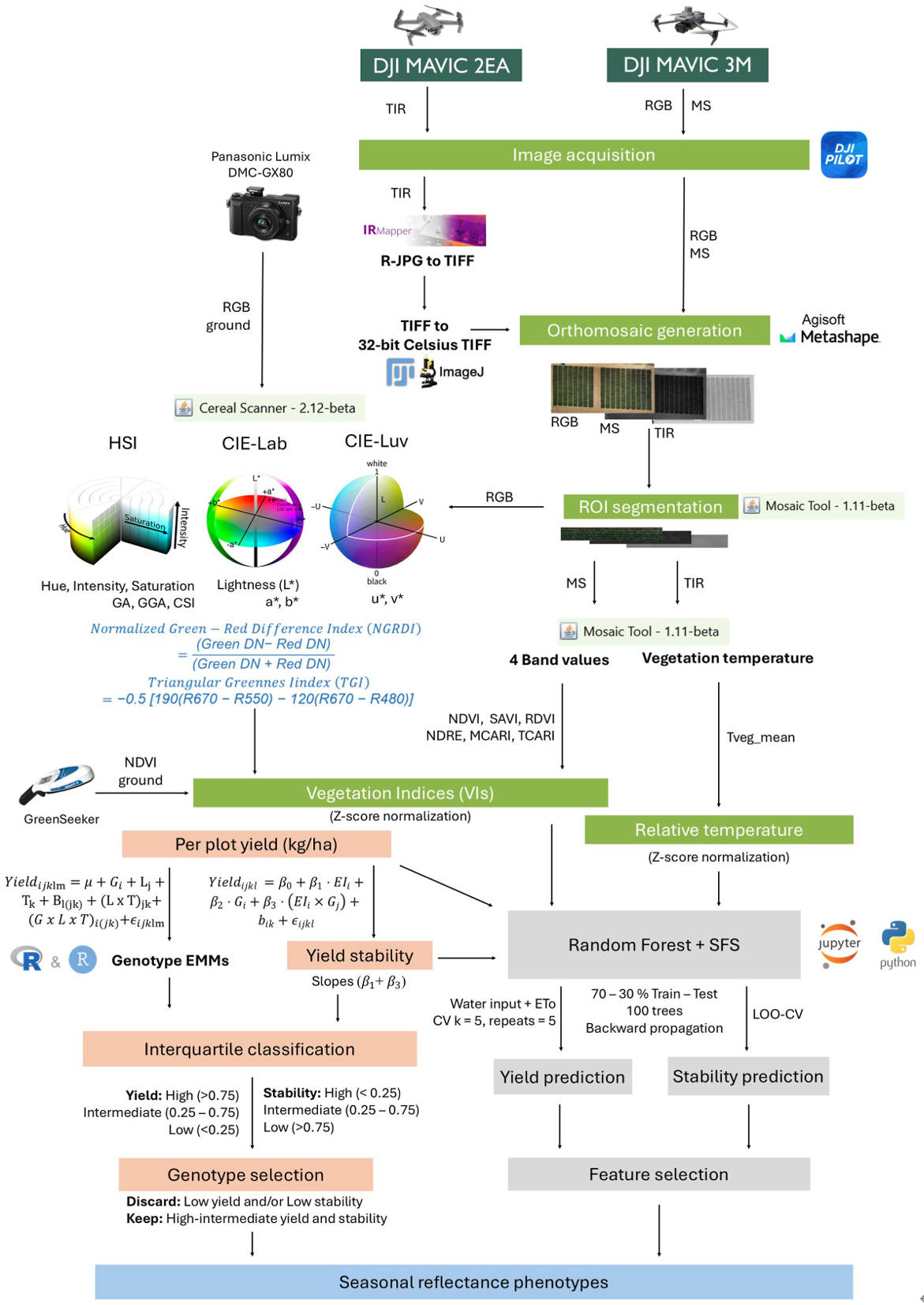
A team led by researchers from the University of Barcelona and the Agrotecnio-CERCA Center, in collaboration with Spain’s Instituto Tecnológico Agrario de Castilla y León (ITACyL) and the National Institute for Agricultural and Food Research and Technology (INIA-CSIC), published (DOI: 10.1016/j.plaphe.2026.100178) the findings on February 5, 2026, in Plant Phenomics. The study evaluated 64 post-Green Revolution durum wheat cultivars under irrigated and rainfed conditions at two contrasting Mediterranean sites in Spain, using unmanned aerial vehicles (UAVs) equipped with red-green-blue (RGB), multispectral (MS), and thermal-infrared (TIR) cameras alongside ground-based sensors.
The researchers analyzed 38 vegetation indices (VIs) derived from both aerial and ground imagery at key growth stages — anthesis and grain filling — as well as the rate of change between them as a proxy for senescence. To isolate genetic effects from environmental noise, they included reference evapotranspiration (ETo) and cumulative water input (WI) as covariates in their models. Using Random Forest (RF) machine learning with sequential feature selection, they achieved robust yield predictions (R² > 0.74) across all environments. More notably, their stability predictions, though more moderate (R² up to 0.56), significantly outperformed previous attempts that relied on single-index approaches. When they grouped genotypes by yield and stability, a striking pattern emerged. High-yielding varieties showed strong early vigor — greater greenness and canopy cover during stem elongation and booting — and maintained these traits until anthesis. Highly stable genotypes, in contrast, exhibited more conservative growth and lower early greenness. By the end of grain filling, high-yielding lines had senesced earlier, while low-stability genotypes maintained green leaves longer — a “stay-green” phenotype that proved disadvantageous for consistent performance. The selected “keep” genotypes — those with intermediate-to-high yield and stability — flowered on average 2.5 days earlier than discarded lines, suggesting that shorter phenology may help avoid late-season drought and heat stress typical of Mediterranean environments.
“What we found really challenges a long-standing assumption in wheat breeding,” said Jara Jauregui-Besó, the study’s lead author from the University of Barcelona and Agrotecnio. “Stay-green is often seen as desirable because it suggests prolonged photosynthesis. But in our multi-environment trial, the varieties that kept their leaves green longest were actually the ones with low early vigor and poor stability — the very ones we would discard. The best performers across both irrigated and rainfed conditions grew vigorously early on and then senesced earlier.” Shawn Carlisle Kefauver, the corresponding author, added: “This gives breeders a practical, cost-effective way to screen for resilience well before harvest — using reflectance data instead of waiting for final yield results.”
The framework offers a scalable pathway for breeding programs to shift from yield maximization alone to a dual focus on productivity and stability. By identifying key vegetation indices that distinguish desirable from undesirable genotypes at early and late growth stages — particularly the Normalized Difference Vegetation Index (NDVI), the Soil-Adjusted Vegetation Index (SAVI), and RGB-derived indices such as Green Area and Hue — breeders can make early selections without running full-season yield trials across multiple locations. This approach is especially valuable in Mediterranean and other semi-arid regions where climate variability is intensifying. The study also suggests that “earlier senescence” should be reconsidered as a positive breeding target, challenging the generalized value of stay-green traits in water-limited environments. With further validation across multiple seasons, this multi-sensor, machine-learning-assisted strategy could accelerate the development of wheat varieties that are both productive and resilient — helping secure food production in an increasingly unpredictable world.
References
DOI
10.1016/j.plaphe.2026.100178
Original Source URL
https://doi.org/10.1016/j.plaphe.2026.100178
Funding information
Spanish project “HolisticWheat” (PID2022-1383070B-C2); FPI doctoral fellowship PREP2022-000560 (MICIU/AEI/10.13039/501100011033 and FSE+); RYC2019-027818-I (MICIU/AEI/10.13039/501100011033 and “El FSE invierte en tu futuro”); EU COST Action CA22136 “PANGEOs”.
Lucy Wang
BioDesign Research
email us here
Legal Disclaimer:
EIN Presswire provides this news content “as is” without warranty of any kind. We do not accept any responsibility or liability
for the accuracy, content, images, videos, licenses, completeness, legality, or reliability of the information contained in this
article. If you have any complaints or copyright issues related to this article, kindly contact the author above.

Media gallery